
What a Dump Truck Load of Gravel Costs in West Tennessee
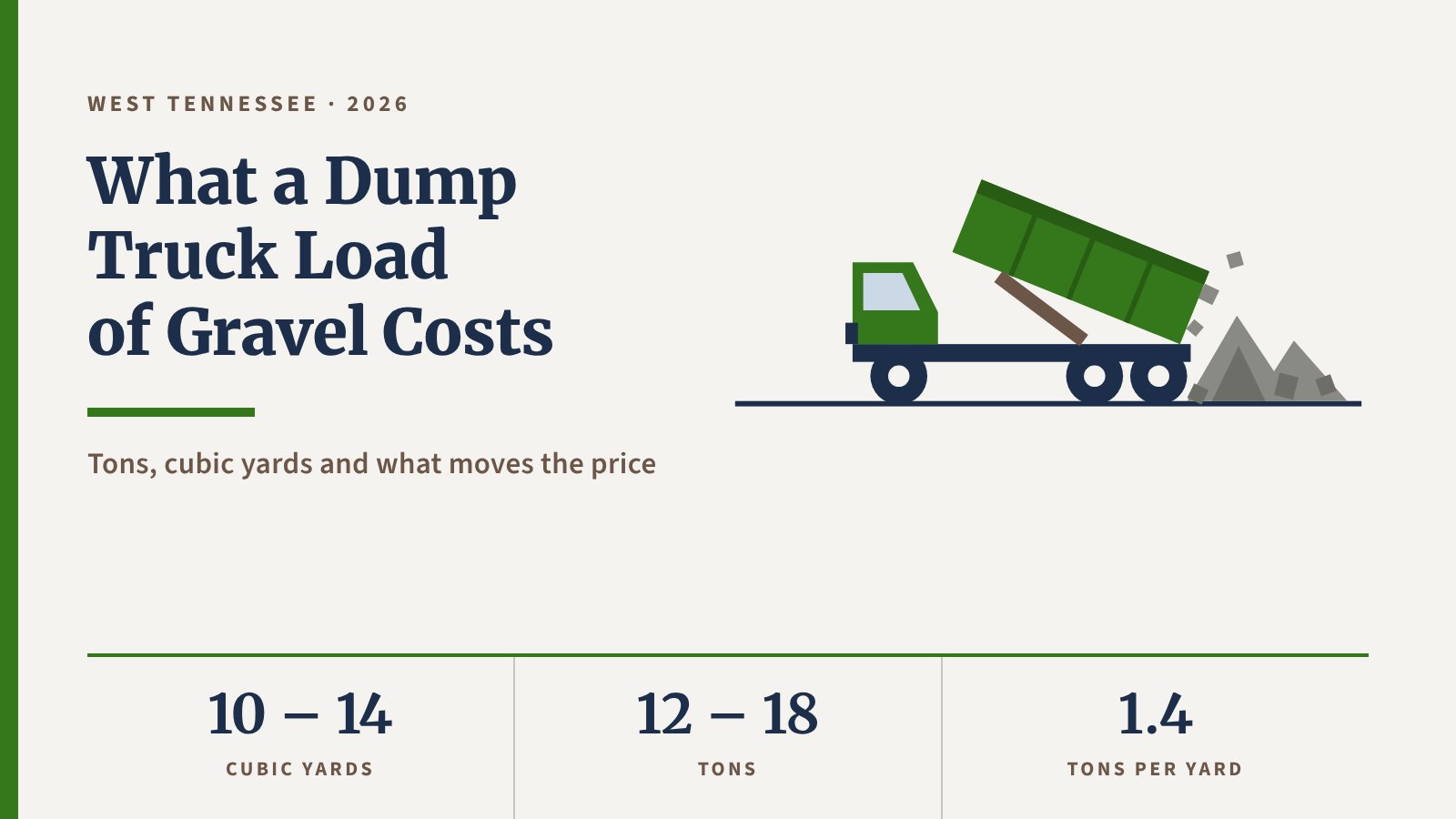
A single dump truck load of gravel delivered in West Tennessee generally runs between $300 and $900, and most residential driveway loads land in the middle of that. The spread is mostly about truck size. A tandem axle truck, the one that shows up at most houses, carries roughly 12 to 18 tons, which is about 10 to 14 cubic yards. A smaller single axle truck brings 6 to 8 tons and costs less overall, though more per ton.
What catches people out here is not the truck. It is the stone. In the Mid-South, sand and gravel comes out of the ground locally and crushed limestone does not, so the two price differently in Millington than they do almost anywhere else in Tennessee. That one fact decides a lot about what you should order.
The Short Answer: What a Load Costs
| Truck size | Typical load | Weight of gravel | Typical delivered cost |
|---|---|---|---|
| Single axle | 5 to 8 cubic yards | 6 to 8 tons | $200 – $400 |
| Tandem axle, the common one | 10 to 14 cubic yards | 12 to 18 tons | $400 – $800 |
| Tri-axle | 12 to 16 cubic yards | 18 to 25 tons | $600 – $1,100 |
Truck capacities are from HomeGuide's 2026 dump truck guide. The cost column is a market range rather than a quote, and it covers the material plus a typical local haul.
On a per unit basis, common gravel and crushed stone runs roughly $30 to $75 per ton, or $40 to $100 per cubic yard, before delivery. Road base and crusher run sit at the cheaper end, around $15 to $35 per ton, and decorative stone runs well above the top. Delivery typically adds $10 to $25 per ton or a flat truck fee. Those are national figures compiled by Fill Dirt Near Me as of November 2026, and they work as a sanity check on a local quote rather than a substitute for one. Aggregate Markets, which delivers into Tennessee, puts small five ton loads at $150 to $300 and full ten to fifteen ton loads at $400 to $800 and up, which is close enough to the table above that you can trust its shape.
Outdoor Services Group does not publish prices, because the honest number depends on your material, your yardage, and how far the truck has to come. We do give free on-site estimates. What follows is everything you need in order to ask for one intelligently.
How Many Tons Actually Come on a Load
Gravel is heavy, and that is the whole reason a truck's cubic yard rating and its tonnage rating almost never line up.
Dry gravel weighs about 2,400 to 2,800 pounds per cubic yard, and crushed rock is similar at 2,500 to 2,800. Wet gravel goes over 3,000, which matters more here than it does in a dry climate, because from December through March our stockpiles are rarely dry. Ten cubic yards of dry gravel is 12 to 14 tons. The same ten yards soaked after a week of rain can be 15 tons or more, and if you are buying by the ton you are paying for that water.
The practical conversion is simple: one cubic yard of gravel is about 1.4 to 1.5 tons. If one supplier quotes per ton and another quotes per yard, multiply the per ton price by 1.4 to compare them fairly.
Legal weight is the other limit. Under Tennessee Code 55-7-203, no single axle may carry more than 20,000 pounds, a tandem axle group is capped at 34,000 pounds, and gross vehicle weight tops out at 80,000 pounds. Those limits, not the size of the bed, are what decide how much stone a truck can legally bring you. It is also why a tri-axle delivers meaningfully more than a tandem with a similar looking bed.
Two Tennessee provisions are worth knowing, because they affect local deliveries specifically. The code gives sand trucks a 10 percent margin of error on weight when they are running on the state highway system rather than the interstate. Separately, a driver hauling crushed stone, fill dirt, rock, soil or bulk sand off the interstate will not be cited on an axle weight limit as long as the total gross stays within what the truck's axle configuration allows. In plain terms, short-haul aggregate deliveries on state and county roads here run with a little more legal room than the headline numbers suggest, which is part of why local loads often come in heavier than a national chart predicts.
Why Crushed Stone Prices Are Different Here
This is the part no national cost guide can tell you, and it changes how you should shop.
West Tennessee is Mississippi River bottomland and loess bluff country. There is sand and gravel in the ground here and there is no hard rock. Memphis Stone & Gravel has been working this market for more than 115 years, and as their vice president Alan Parks put it in July 2026, "for decades, our business has primarily focused on sand and gravel products." Not stone. Stone had to come from somewhere else.
In July 2026 that company opened a six acre River Yard on the Mississippi in Memphis for the specific purpose of receiving limestone barged down from Warren Paving's Slats Lucas Quarry in Salem, Kentucky, carrying 610s, No. 8, 810, No. 57 and No. 4 stone. Parks described it as "putting the stone back in Memphis Stone & Gravel."
What that means for you as a buyer is straightforward. Crushed limestone in this market carries freight that limestone in Middle Tennessee does not, because it arrived by barge and then by truck rather than coming off a quarry face twenty miles away. River gravel and sand are the home team here. So when a national article tells you crushed limestone is the cheap default for a driveway, that advice was written for a place with a limestone quarry down the road. Here it is worth pricing both and asking your supplier where the material is coming from, because the answer moves the number.
The second thing it means is that supply improved in 2026. More stone moving through a local river yard means more competition on stone, which is a good reason to get a fresh quote rather than assume last year's price.
How Much Gravel Your Driveway Needs
You can work this out in about thirty seconds, and doing it before you call saves you from ordering a load and a half when you needed two.
Cubic yards = (length in feet × width in feet × depth in inches) ÷ 324. Then multiply cubic yards by 1.4 to get tons.
| Project | Size and depth | Cubic yards | Approx. tons | Loads |
|---|---|---|---|---|
| Short residential drive | 10 ft × 50 ft at 4 in | 6.2 | 8.6 | One single axle |
| Standard drive, topping up | 12 ft × 100 ft at 4 in | 14.8 | 20.7 | One tandem, close to full |
| Standard drive, new base | 12 ft × 100 ft at 6 in | 22.2 | 31.1 | One tri-axle plus |
| Shed or equipment pad | 20 ft × 40 ft at 6 in | 14.8 | 20.7 | One tandem, close to full |
| Barn or mobile home pad | 30 ft × 60 ft at 6 in | 33.3 | 46.7 | Two tri-axles |
Order slightly over rather than slightly under. Gravel settles and compacts, a second partial load costs more per ton than the first full one, and the leftover always finds a low spot.
Depth, and Why Four Inches Is Usually Wrong for a New Drive
Four inches is a top-up depth. It is what you spread on an existing drive that already has a compacted base under it. If you are building a new drive over bare loess, four inches of stone will be down in the subsoil by the second wet winter, because fine silty soil pumps up through a thin stone layer every time a vehicle loads it.
A new drive on this soil wants six to eight inches placed in lifts and compacted, usually with geotextile fabric underneath to keep the stone and the silt apart. That is a different job from a delivery, and it needs excavation and grading rather than just a truck. If you are not sure which one you have, that is a reasonable thing to ask about when you get an estimate.
Which Gravel to Actually Order
| Material | Best for | Notes for this area |
|---|---|---|
| Crusher run (crushed stone with fines) | Base layers, new drives, pads | Compacts hard and locks together. The right base material. |
| No. 57 stone | Drainage, top layer, culvert backfill | Washed, no fines. Drains well but does not compact. |
| River gravel or pea gravel | Paths, beds, drainage | Local and rounded. Rolls rather than locks, so poor on a slope. |
| Fill sand | Bedding, backfill, leveling | Cheapest local material. Not a driving surface. |
The common mistake on a West Tennessee driveway is ordering No. 57 alone because it looks clean sitting in the yard. Washed stone with no fines has nothing to bind it, so it migrates, and on loess it works its way down. Crusher run as a base with a thinner wearing course over it holds up far better through our wet months.
The second mistake is rounded river gravel on anything with a slope. It is local and reasonably priced, which is exactly why people choose it, but round stone under a tire behaves like ball bearings.
What Moves the Price on Your Quote
Haul distance. Trucking is often the largest single component. A load going out to Covington or Brighton costs more than the same load dropped in Millington, and it is not a small difference.
Material. Crusher run is usually the cheapest useful driveway stone. Washed and screened products cost more, and imported limestone carries the freight described above.
Quantity. A full truck is cheaper per ton than a partial one, because the trip costs the same either way. If you are close to a full load, filling it is usually the better buy.
Access. A truck needs room to back in and firm ground to lift a loaded bed on. Soft ground in February, a tight turn, low limbs or overhead wires can all force a smaller truck and more trips.
Spreading. A delivery means the material comes off in a pile, or tailgated in a windrow if the driver can manage it. Spreading, grading and compacting is labor and equipment on top of the stone.
Timing. Wet material weighs more and wet ground is harder to work. Winter is when most drives need stone and also when the delivery is most likely to be awkward.
If you want a real number rather than a range, we will come and look at it. Call (901) 350-5116 for a free on-site estimate anywhere in Tipton County, Shelby County and the surrounding area. We will measure the drive, tell you what depth it actually needs, and put the material and the quantity in writing before anything is ordered.
Delivered or Picked Up
Picking it up yourself skips the delivery charge, and for one or two yards that can make sense. Past that it stops working quickly.
A cubic yard of gravel weighs around 2,800 pounds. That is more than the payload rating of most half ton pickups, so a single yard can overload a truck that looks big enough for it. A three quarter ton or one ton handles one to two yards. A fifteen yard driveway job would be eight or more round trips, plus loader time at the yard on each visit, plus fuel, plus the wear on the truck. Delivery is almost always cheaper and always faster once you are past a couple of yards.
Trailers are the middle option, and the same arithmetic applies. Check the trailer's rating against 2,800 pounds per yard, not against how much space is in it.
Getting a Real Number for Your Property
Every figure above is a range, because a range is what anybody can honestly give you without seeing the site. The variables that actually set your price are how far the truck drives, which material your drive needs, and whether what you have is a delivery or a base rebuild. Those take five minutes to settle in person and cannot be settled from a search result.
Outdoor Services Group has been working on properties in West Tennessee since 2008. We are family-owned, licensed and insured, and our crews work in English and Spanish. We handle material delivery, excavation and grading, light hauling and land management across Millington, Atoka, Munford, Covington, Brighton, Arlington, Bartlett, Lakeland, Germantown, Collierville and the greater Memphis area. If you are also weighing up clearing work on the same property, our guide to what land clearing costs per acre covers that side of it.
Call (901) 350-5116 or reach us through our contact page and we will get you a straight number.
Frequently Asked Questions
Ready to Get Started?
Contact Outdoor Services Group for a free, no-obligation estimate on any of our outdoor services in Tipton County and Shelby County.