
Is That Tree Leaning Over Your House Actually Dangerous?
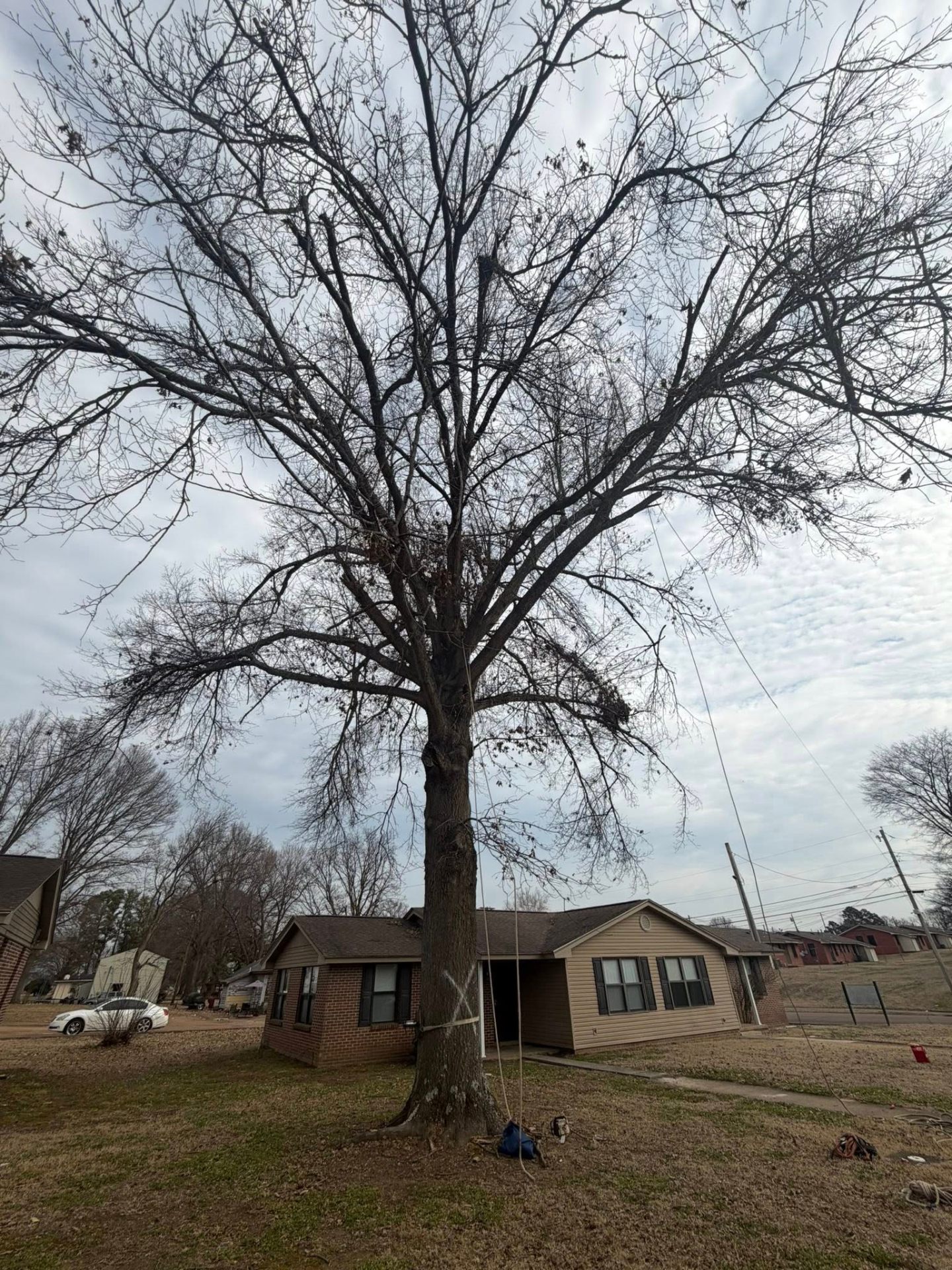
Start with one question, because it decides everything else: has that tree always leaned, or did the lean show up recently? A tree that grew at an angle, reaching around a building or toward open light, has spent years building reaction wood and root structure to hold itself there. It is usually stable. A tree that was vertical last spring and is tilted now has not adapted to anything. Something moved underneath it, and the thing that moved is the root plate.
Old lean is a landscaping question. New lean is a removal question, and in West Tennessee it is often an urgent one, because the soil here gives up its grip faster than most people expect. The rest of this page is how to tell which one you have from the ground, in about five minutes, without a ladder.
Old Lean vs. New Lean: The Only Distinction That Matters
Nearly everything written about leaning trees fixates on the angle. The angle is the least useful number available to you. A sweet gum that has leaned twenty degrees over a driveway since the Clinton administration is far safer than an oak that moved four degrees last Thursday night.
Here is what separates them in practice.
A lean the tree grew into shows a trunk that curves. The tree corrected toward vertical as it grew, so the base angles out and the upper trunk swings back up toward the sky. The soil at the base is flat and undisturbed, turf grows right up to the bark, and the root flare, the widening where the trunk meets the ground, looks the same on every side.
A lean from root failure shows a trunk that stays straight and simply tips, like a pole pushed over. The whole tree moved as a unit because the root plate rotated. That rotation leaves evidence on the ground, and the ground is where you should be looking.
The Five-Minute Check You Can Do From the Ground
Walk the base of the tree and give it a full circle. You are not assessing the canopy. You are reading the dirt.
- A mound or hump on the side opposite the lean. When a root plate rotates, it levers the far side of the plate upward. A low dome of soil, often with the turf cracked or domed over it, is the single most reliable sign of active root failure. Treat it as serious.
- A crescent-shaped crack or gap in the soil on the lean side. The plate is pulling away from the surrounding ground. Fresh soil crumbs at the edge mean it moved recently.
- Exposed roots that were not exposed before, or roots that look lifted rather than simply worn bare by foot traffic.
- A missing or buried root flare. If the trunk enters the ground like a telephone pole with no flare at all, the roots may be girdled, rotted, or buried too deep. A flare on three sides and none on the fourth is worse.
- Mushrooms or shelf fungus at the base or on the lower trunk. Fruiting bodies at the root collar generally mean decay is already well advanced inside the wood you cannot see.
- Soft, punky, or hollow-sounding wood at the base. Tap around the lower trunk with a mallet or the heel of your hand and listen for a change in tone.
Then do the one thing almost nobody does: take a photograph, from a fixed spot you can find again, with something vertical in the frame such as a corner of the house, a fence post, or a utility pole. Date it. Take the same photo after the next storm. Two photos from the same spot will tell you in seconds whether the lean is progressing, and that is information no arborist can give you about the past and no amount of staring at the tree will produce.
The "15 Degrees" Rule, and What It Is Actually Good For
Search this topic and you will run into a fifteen-degree threshold repeated on tree-service sites across the country, usually stated as though it were a building code. Treat it as a prompt to get eyes on the tree, not as a verdict.
The reason angle alone fails is that it describes the load without describing the anchorage. Two trees at identical angles can sit at opposite ends of the risk scale depending on root health, decay, soil condition, species, and crown weight. A fifteen-degree lean on a sound tree in firm ground with a full root plate may outlive you. A five-degree lean on a tree with a rotted collar and a mounded root plate is a tree waiting for the right storm.
So use the angle the way a thermometer is used: as one reading, not a diagnosis. The ground-level evidence above tells you far more.
Why Trees Topple Here: Saturated Soil Plus Wind
This is the part the national guides skip, and it is the reason trees come down in West Tennessee on nights that would not trouble a tree in Denver.
A standing tree resists wind through friction between its roots and the surrounding soil. As the Alabama Cooperative Extension System explains it, wind pushes the canopy, the trunk acts as a lever, and that force transfers down into the root plate. When the soil is completely saturated and the tree starts moving, the wet soil takes on what they describe as a "gravy-like consistency," and the roots slip through it instead of being held by it. If the wind holds, the tree goes over.
That is a description of a West Tennessee winter. Our trees are not usually brought down by spectacular wind. They are brought down by ordinary wind arriving on the third straight day of rain, when the ground has no grip left to give. A forty-mile-an-hour gust in January, after a week of soaking rain on ground that never dries out, does damage that the same gust in August would not.
Extension also flags the conditions that make a root plate weak to begin with, and they are common on developed lots here:
- Compacted soil, which pushes roots shallower because the pore space they need for oxygen is gone. Shallow plates anchor poorly in soupy ground.
- Roots cut or damaged within eight to ten feet of the trunk, or nearby trenching. If you have put in a driveway, a patio, a pool, a fence line, or a utility run near a mature tree in the last few years, that tree's anchorage is not what it was.
- Existing root rot or decay, which removes holding capacity invisibly.
- Trees in tight spaces, hemmed in by pavement or structures so the plate never developed in one direction.
Species matters too. University of Tennessee Extension's own publication on trees to reconsider before planting, by Wayne Clatterbuck and Donna Fare, singles out silver maple as a "short-lived tree with brittle wood prone to limb breakage during wind and ice storms," with shallow, dense roots and a working life of roughly twenty-five to forty years. It flags hackberry as prone to ice damage, and cottonwood and boxelder for weak wood and shallow roots. If the tree over your roof is one of those and it is middle-aged or older, it deserves a closer look than a white oak of the same size would.
If the Tree Is Near a Power Line, It Is Not Yours to Cut
This one catches people out every winter, and getting it wrong is how homeowners get killed.
MLGW's position is explicit: never attempt to trim limbs that are near or touching power lines. Call them instead. Their crews trim trees that threaten distribution lines, and where a trunk sits close enough to the pole line to endanger it, roughly ten to fifteen feet depending on the voltage, MLGW removes the tree. With written consent they will also remove a diseased or dead tree that poses a hazard to the lines.
There is an important limit. MLGW trims around the overhead service line running to your house to maintain about five feet of clearance, but they do not remove trees simply because one interferes with a service drop. That tree stays your responsibility. Their own guidance puts it plainly: if you are a property owner with very large trees, it is incumbent upon you to trim them.
So the practical sequence when a leaning tree is anywhere near a line is: call MLGW's Customer Care Center at (901) 544-6549 first and let them tell you what falls to them. Whatever is left is a job for a tree crew with the rigging to take it down in controlled pieces, which is work we do regularly on tree services calls across Millington and the surrounding counties. If your water and power come from Millington, Atoka, Munford or Covington rather than MLGW, the principle holds but call your own utility.
What Your Insurance Will and Will Not Pay
Here is the part that surprises almost everyone, so it is worth being blunt about it.
A standing tree leaning toward your house is almost certainly not an insurance claim. Preventive removal is generally not covered by a standard homeowners policy, and healthy trees that have not damaged a covered structure are a common written exclusion. Insurers treat a leaning tree as maintenance, which means the removal comes out of your pocket.
Coverage usually turns on three things:
| Situation | Typical outcome |
|---|---|
| Tree still standing, leaning, no damage | Not covered. Homeowner's expense. |
| Tree falls in a storm and hits a covered structure | Generally covered, subject to deductible |
| Tree falls and hits nothing | Limited or no coverage for removal |
| Neighbor's tree falls on your house | Usually your own policy responds |
Even when a claim is paid, debris removal is often capped, commonly around $500 per tree and $1,000 per incident, which does not go far against the cost of taking down a mature hardwood that landed on a roof.
The sting in the tail is negligence. If a tree was visibly rotting or hazardous, you were on notice, and you did nothing, liability can shift to you when it falls, including onto a neighbor's property. That cuts both ways and it is the strongest financial argument for getting a documented look at a tree you are worried about. A dated photograph and an estimate on file are cheap, and they establish that you acted.
If the ground is mounded, the trunk is tipping, or the lean has changed since the last storm, do not wait for the next one. We provide free, no-obligation estimates throughout Tipton County, Shelby County and the surrounding West Tennessee communities, and we run 24-hour emergency service when a tree is already on something. Call (901) 350-5116.
When It Is Your Neighbor's Tree: What Tennessee Law Says
Tennessee has a clearer answer here than most states, and it comes from a 2002 Tennessee Supreme Court decision, Lane v. W.J. Curry & Sons, which happens to have come out of Memphis.
The court drew the line in two parts:
- Encroaching trees are not a nuisance merely because they cast shade, drop leaves, flowers or fruit, or extend branches and roots over the line. Ordinary mess is not a legal problem.
- They are a nuisance when they cause actual harm, or pose an imminent danger of actual harm, to the adjoining property. At that point the tree's owner can be held liable for the harm, can be required to cut the encroachment back, and a court can order the nuisance abated, which can mean ordering the tree removed.
Separately, and regardless of any of the above, Tennessee still allows self-help: you may cut encroaching branches and roots back to the property line at your own expense. What you may not do is cross the line, and you should be careful, because cutting one side of a canopy can make a marginal tree less stable rather than more.
The practical move with a neighbor's leaning tree is to document it and tell them in writing. A dated photo and a short note establishes that they are on notice, which is the fact that matters most if it later comes down. Lead with the conversation, not the letter. Most people genuinely do not know the tree is a problem until somebody shows them the mounded soil at its base.
What Removal Costs
We do not publish fixed prices, because the honest answer is that the number depends on size, lean direction, what is underneath it and how much room a crew has to work. What we can give you is the market range so you know whether a quote is sane.
Angi puts average tree removal around $750, with most jobs landing between $200 and $2,000, scaling with height:
| Tree height | Typical cost |
|---|---|
| Up to 30 feet | $150 – $450 |
| 30 – 60 feet | $450 – $1,200 |
| 60 – 80 feet | $800 – $1,500 |
| Over 80 feet | $1,000 – $2,000 |
Three things push a leaning-tree job toward the top of that range, and all three apply to the trees people call us about:
- Tight or hazardous access. Work near structures or power lines commonly runs 25 to 50 percent more, because the tree has to come down in controlled pieces rather than being felled.
- Crane work. On very large trees a crane adds meaningfully to the bill, and on a tree over a roof it is sometimes the only safe method.
- Emergency timing. Urgent removal after a tree is already leaning on something carries a premium, and it is the most expensive way to buy this service.
Which is the practical argument for dealing with a tree in October rather than in the middle of February. The same tree costs less when it is still standing, the ground is workable, and nobody is working around a damaged roof.
What You Can Handle, and Where It Stops
Genuinely homeowner work:
- Walking the base and checking for mounding, cracking and fungus
- Taking dated reference photos from a fixed spot
- Clearing vehicles, grills, play equipment and anything else out from under the lean
- Staking and straightening a young, recently planted tree, which is a genuinely different job from a mature one
- Telling a neighbor, in writing, about a tree of theirs that concerns you
Where it stops, without qualification:
- Anything within reach of a power line. Call the utility.
- Trying to winch, cable or pull a mature tree upright. Once a root plate has rotated, the anchorage is gone and standing the tree back up does not restore it.
- Cutting a leaning tree yourself. A tree under tension does not fall where an untrained person expects, and the leaning ones are exactly the trees that kill people doing this at home.
- Any tree over a roof, a vehicle, a fence line or a neighbor's property.
One more honest note: not every leaning tree needs to come down. Plenty of them need nothing, and some need only crown reduction to cut the sail area and the leverage. A crew that tells you every leaning tree is an emergency is selling, not assessing. We would rather look at it and tell you it is fine, because that is the call that earns the next one.
Getting Someone Out to Look at It
If you have a tree with mounded soil at the base, a lean that has visibly changed, or a trunk tipping straight rather than curving, that is the one to deal with before the winter rain arrives and the ground softens for the season.
Outdoor Services Group has been working on properties in West Tennessee since 2008. We are family-owned, licensed and insured, our crews work in English and Spanish, and we handle tree removal near structures and power lines with the rigging to bring it down in pieces rather than dropping it. Alongside tree services we handle debris removal and 24-hour storm cleanup, vegetation and brush management, and property safety checks for vacant and seasonally occupied homes, which is where unnoticed tree problems tend to turn into expensive ones.
If you want the broader picture on when a tree has reached the end of its life, our guide to tree services and tree removal in Tipton and Shelby County covers the other warning signs worth knowing.
Call (901) 350-5116 or reach us through our contact page for a free estimate. We serve Millington, Atoka, Munford, Covington, Brighton, Arlington, Bartlett, Lakeland, Germantown, Collierville and the greater Memphis area.
Frequently Asked Questions
Ready to Get Started?
Contact Outdoor Services Group for a free, no-obligation estimate on any of our outdoor services in Tipton County and Shelby County.