
How Much Does Land Clearing Cost Per Acre in West Tennessee?
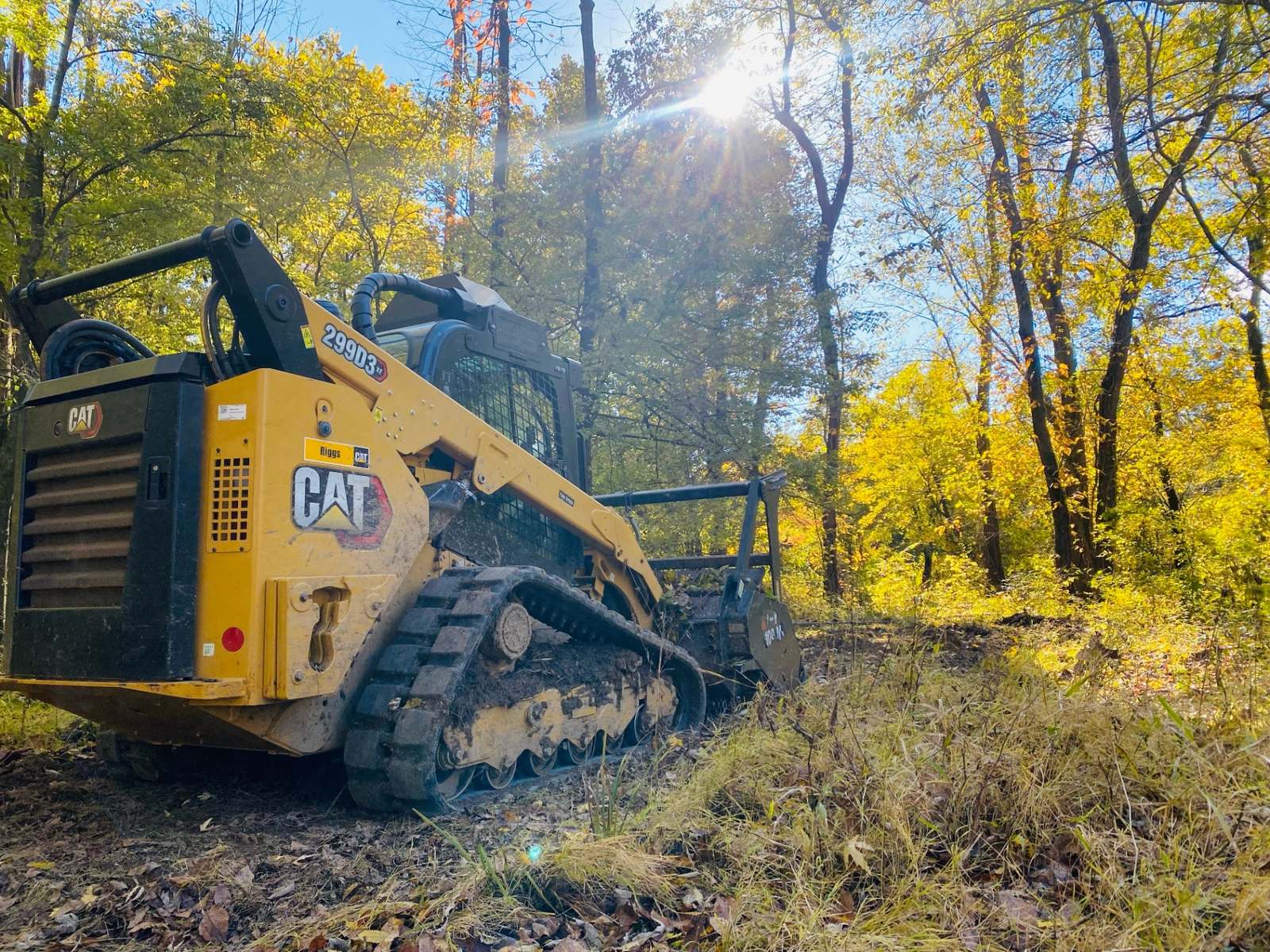
Land clearing in West Tennessee generally runs between $500 and $5,000 per acre, and most jobs land somewhere in the middle of that. Light brush and saplings sit at the bottom. Mature hardwood with stumps pulled and hauled off sits at the top. The reason the range is so wide has less to do with how many acres you have and more to do with which method the job calls for. Forestry mulching on the same acre can cost a third of what full clearing with haul-off costs, and for a lot of properties around Millington, Atoka, and Covington, mulching is all the property actually needs.
Here is what drives the number, what the two main methods really cost, and the permit rules in Tennessee that quietly affect your bill.
The Short Answer: What Land Clearing Costs Per Acre
| Type of work | Typical cost per acre | What you get |
|---|---|---|
| Light brush, saplings, tall grass | $500 – $1,500 | Overgrowth knocked down, small stems cleared |
| Moderate growth with some stumps | $1,500 – $3,000 | Mid-size trees removed, stumps ground or pulled |
| Heavy woods, mature trees, full haul-off | $3,000 – $5,000+ | Everything down, stumps out, debris hauled away |
| Forestry mulching (any of the above) | $400 – $2,000 | Vegetation ground in place, no haul-off, roots left |
Those first three tiers line up closely with what other Tennessee contractors publish. SmokyTop Contractor puts East Tennessee work at $500–$1,500 for brush, $1,500–$3,000 for moderate clearing with stumps, and $3,000–$5,000 and up for heavy forest. The Yard Force gives a statewide range of $700 to $5,900 per acre with an average around $3,100.
Forestry mulching is priced differently, and that is where most people find their savings. HomeGuide reports $400 to $800 per acre for typical work, climbing toward $2,000 for genuinely dense overgrowth, with hourly rates from $125 to $400 depending on what is being ground. Angi puts it higher, at $1,000 to $2,500 per acre or $150 to $300 per hour. The gap between those two sources is real and it tells you something useful: mulching prices swing hard on density, and nobody can quote you honestly without seeing the property.
Most contractors, including us, also carry a minimum. Below roughly half an acre, you are usually paying a day rate or a minimum fee in the $400 to $600 range, because moving equipment onto the site costs the same whether the job takes two hours or eight.
Why the Range Is So Wide
Six things move the price, roughly in order of how much they matter.
Vegetation density. This is the big one. An acre of five-year-old pasture regrowth and an acre of forty-year-old oak are the same acre on paper and nowhere close on a quote. Density determines machine hours, and machine hours are the cost.
What happens to the debris. Grinding material in place is cheap. Loading it, hauling it, and paying tipping fees is expensive, and on a heavily wooded lot the haul-off alone can be a third of the total. This is the single largest lever most landowners do not realize they control.
Stumps. Leaving stumps, grinding stumps to grade, and excavating root balls out entirely are three different prices. If nothing is getting built, you often do not need them out at all.
Access and terrain. A property with a gate wide enough for a lowboy and firm ground to work on prices better than one where equipment has to be walked in through a neighbor's field. Wet ground is its own problem and we will come back to it.
Slope and obstacles. Old fence wire, buried debris, septic lines, and utility easements all slow the work down. Barbed wire wrapped around a mulcher head is a genuinely expensive afternoon.
Total acreage. Bigger jobs cost more overall but usually less per acre, because mobilization gets spread across more ground. Ten acres rarely costs ten times what one acre costs.
Forestry Mulching vs. Traditional Clearing: The Cost Difference
Traditional clearing means cutting everything, pushing it into piles, and either burning it or hauling it off. Forestry mulching means running a machine with a rotating drum of carbide teeth over the vegetation and grinding it into chips that stay on the ground as mulch.
The cost difference comes down to one thing: nothing leaves the property. No trucks, no dump fees, no burn piles, no second crew. On a lot where traditional clearing might run $3,000 an acre, mulching the same lot can come in under $1,000. It is also usually one machine and one operator instead of a dozer, a loader, and a hauling crew.
When Mulching Is the Cheaper Choice
Mulching is typically the right call when you want the land usable rather than bare:
- Clearing overgrown pasture back into grazing or hay ground
- Opening fence lines, property boundaries, and access trails
- Knocking back privet, honeysuckle, and other brush that has taken over
- Improving hunting land, food plots, and shooting lanes
- Cleaning up a lot you want to look at, walk through, or mow
- Any project where erosion is a concern, since the chip layer holds soil in place
When You Still Need Traditional Clearing
Here is the honest limitation, and it is the part most pricing articles leave out. A forestry mulcher grinds vegetation down to grade but leaves the root system in the ground. For most property owners that is fine. For some it is not.
If you are pouring a foundation, running utility trenches, installing a septic field, or building a road, those roots have to come out. That means grubbing and excavation and grading after the mulching, which is a second line item. Large-diameter trees also fall outside what a mulcher handles well and get priced separately as tree removal.
The practical answer for a lot of West Tennessee properties is both: mulch the brush and small stems to open the site up cheaply, then bring in excavation only where the building envelope actually is. Clearing an entire ten-acre parcel to construction grade when you are putting a house on one acre of it is the most common way landowners overspend.
What Makes West Tennessee Land Different
Cost guides written for the rest of the country miss what actually grows here.
The invasive load is heavy. Chinese privet has taken over bottomland across Tipton and Shelby County, and it does not behave like ordinary brush. It grows in dense multi-stem thickets that resist a single pass, and it comes back from the root if you only cut the tops. Japanese honeysuckle and kudzu add to it. Property that looks like light brush from the road can be a genuinely dense mulching job once you walk fifty feet into it, and that is a common source of quotes coming in higher than an owner expected.
The ground stays wet. West Tennessee is Mississippi River bottomland and loess bluff country, not the rocky Appalachian ground you find on the other end of the state. Low-lying parcels near the Loosahatchie and Wolf River bottoms hold water well into spring. Wet ground means equipment ruts, slower progress, and sometimes a job that has to be rescheduled outright. It is the main reason timing matters so much here.
The soil erodes easily. Loess is windblown silt, and it moves fast once you strip the cover off it. Leaving a mulch layer instead of bare dirt is not just cheaper on these soils, it is genuinely better for the property, and it matters for the permit question below.
Permits and Regulations That Affect Your Cost
Two rules in Tennessee affect what a clearing job costs, and neither one shows up on the national pricing pages.
Burn permits run October 15 through May 15. If your project involves burning debris piles, the Tennessee Division of Forestry requires a permit during that entire window. Permits are free and available online at tn.firesponse.com seven days a week from 8am to 11pm, or by phone at 877-350-BURN. The detail that catches people out is that a permit is good for one day only, so it has to be pulled the morning you intend to burn, not in advance. Barrel fires with a half-inch mesh screen are exempt, but that is not going to help with a clearing project. If burning is off the table for your site, that debris gets hauled instead, and the cost goes up accordingly. Ask your contractor which assumption their quote is built on.
Disturbing one acre or more triggers a stormwater permit. Under the Tennessee Construction General Permit, any construction activity disturbing one acre or more of total land area requires NPDES stormwater coverage through TDEC. It also applies to smaller sites if they are part of a larger common plan of development or sale. This is a real line item with a real cost, and on erodible loess soils it is enforced. Notably, forestry mulching that leaves ground cover in place is a very different erosion picture than pushing an acre down to bare dirt, which is one more reason the method choice matters beyond the equipment rate.
How to Read a Land Clearing Quote
Contractors price three ways, and knowing which you are looking at prevents most billing surprises.
Per acre is the most common and works well when the density is consistent across the property. It is predictable, and it is what you want for a straightforward job.
Per hour typically runs $125 to $400 depending on the equipment and what is being cleared. Hourly is honest on unpredictable ground, where nobody can tell what is in there until the machine starts. It is riskier for you because the number is open-ended, so ask for a not-to-exceed cap.
Per day runs roughly $1,000 to $1,600 for a skid steer mulcher with an operator, and more for a tracked mulching tractor. Day rates usually make sense on multi-day jobs.
A quote worth trusting should tell you: which method is being used, whether stumps are included and to what depth, what happens to the debris, whether a burn permit is assumed, whether haul-off and dump fees are in the number or extra, and what happens if the crew hits buried wire or a wet spot. If a quote is one line and one number for five acres of unseen ground, ask more questions.
A real number for your property takes a site visit. We provide free on-site estimates across Tipton County, Shelby County, and West Tennessee. Call (901) 350-5116 and we will walk the property with you, tell you honestly whether mulching alone will do what you need, and put the scope in writing before anything starts.
The Best Time of Year to Clear Land in West Tennessee
Fall and winter are the right season here, and it is not close.
Once the leaves drop, you can actually see the property and what is in it, which makes for a more accurate quote. Vegetation is dormant, so cut brush is slower to come back and you get more seasons out of the work. Ground that is soft and rutted in April is usually firm enough to work in December and January. The ticks, chiggers, and snakes that make summer bottomland work miserable are gone. And the burn permit window opens October 15, right as the season starts.
Spring and summer clearing is doable and sometimes necessary, but you are working against regrowth, wet ground, and a busier schedule. If your project is not urgent, booking in late summer for fall work gets you better access and usually a better spot on the calendar.
Getting an Accurate Number for Your Property
Every number in this article is a range, because that is all anyone can give you honestly without standing on the property. The variable that matters most, how dense the growth actually is once you get past the road frontage, is the one you cannot judge from a satellite image or a phone call.
Outdoor Services Group has been clearing land in West Tennessee since 2008. We are family-owned, licensed and insured, and our crews work in English and Spanish. We handle forestry mulching, land management, excavation and grading, tree removal, vegetation and brush management, and debris removal across Millington, Atoka, Munford, Covington, Brighton, Arlington, Bartlett, Lakeland, Germantown, Collierville, and the greater Memphis area.
If you have a piece of land you have been putting off, now is the season to get it on the calendar. Call (901) 350-5116 or reach out through our contact page for a free estimate.
Frequently Asked Questions
Ready to Get Started?
Contact Outdoor Services Group for a free, no-obligation estimate on any of our outdoor services in Tipton County and Shelby County.