
When Is the Best Time to Prune Trees in West Tennessee?
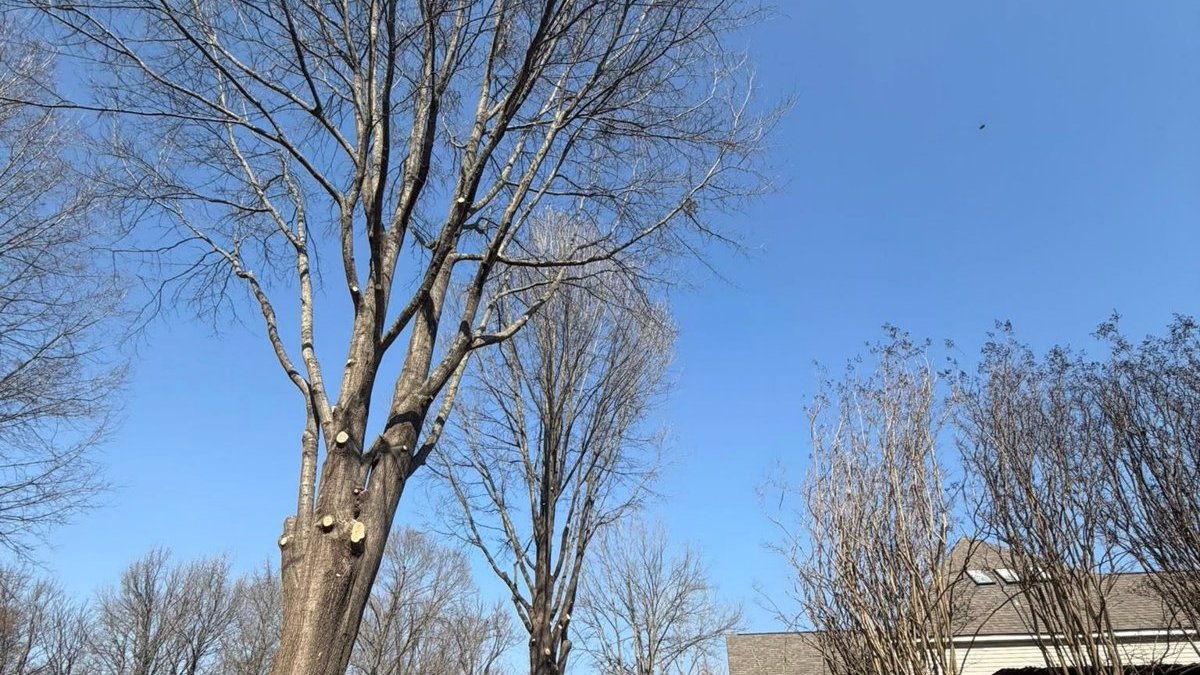
For most shade trees in West Tennessee, the window is December through February, and the back half of it is better than the front. You want the tree fully dormant, the leaves down so the structure is visible, and the cuts made close enough to spring that the tree starts sealing them within weeks rather than sitting open all winter.
That is a narrower window than what you will read almost anywhere else, and the difference matters here more than it does in most of the country. The national articles tell you February and March. In Tennessee, March is the month the state tells you to stop touching oaks. If you have oaks, and around here you almost certainly do, the advice on page one of a search result will walk you straight into the one month you should avoid.
Why the Standard Advice Does Not Fit This Part of the Country
Search for the best time to prune and you get a remarkably consistent answer. Iowa State Extension says February through March is generally regarded as the best time for most deciduous trees. The Morton Arboretum, in Illinois, says late fall through very early spring. The national home services sites round it to late February through early March and call it the sweet spot. Several of the tree companies ranking for the question are writing from Pennsylvania, Colorado and the Bay Area.
None of that is wrong. It is just written for a different winter. Those recommendations come from places where the ground is frozen into March and bud break does not arrive until April, so the end of February is genuinely the tail of dormancy. Memphis is not that. The 2023 USDA Plant Hardiness Zone Map moved the Memphis area from zone 7b to zone 8a, with average annual minimum temperatures of 10 to 15 degrees. Our dormancy is shorter at both ends, and it breaks earlier.
So when a national article says late February, it means the last safe moment before growth. Here, late February is already the edge. Maples and elms are moving sap, early bloomers are swelling buds, and the beetles that matter for oaks are about three weeks from showing up.
The Oak Rule, and It Comes From the State
This is the part worth reading twice, because it is specific to Tennessee and it is the single most expensive mistake available on this topic.
Oak wilt is a fungal disease that moves between trees two ways: underground through grafted roots, and above ground on sap-feeding beetles that are drawn to fresh wounds. A pruning cut made while those beetles are flying is an open invitation. In red oaks the disease can kill a mature tree within a single season.
The Tennessee Department of Agriculture's guidance on its Protect TN Forests oak wilt page is direct: avoid pruning oaks during the months when the spore-vectoring beetles are most active, March through July. The University of Tennessee Institute of Agriculture covers the same ground in its publication W1272 on recognizing and managing the disease. Extension services in other states draw the line in the same place for the same reason. Michigan State names November through March as the safest stretch for oaks; Penn State says December through March.
Line that up against the national advice and the problem is obvious. The window everyone recommends ends in March. The window Tennessee tells you to keep oaks out of begins in March. For an oak in Shelby or Tipton County, the overlap is not a technicality, it is a month of real risk, and it falls precisely where most people have been told to schedule the work.
If an oak has to be cut outside the safe window because a limb came down on a roof or a split is threatening something, that work still happens. Storm damage does not wait for a calendar. The difference is that an emergency cut gets sealed over immediately rather than left open, and nobody does that kind of work in April by choice.
What to Prune and When, Around Here
Not everything in a West Tennessee yard follows the same schedule. The two things that move a species off the default are whether it is an oak and whether it blooms in spring.
| What you have | When to prune it here |
|---|---|
| Oaks (willow, water, red, white, post) | December through February. Stop by the end of February and do not resume until August. |
| Maple, elm, sweetgum, hackberry, poplar | December through February. They bleed sap if cut late, which looks alarming and is harmless. |
| Pecan and hickory | Dormant season, same window. Prune before the buds swell. |
| Bradford and other ornamental pears | Dormant season, with structural thinning as the priority given how these fail. |
| Crape myrtle | Late winter, January into February, before new growth. Remove suckers and crossing wood, not the tops. |
| Dogwood, redbud, saucer magnolia, flowering cherry, crabapple | Right after they finish blooming in spring. Winter pruning cuts off this year's flowers. |
| Pine and other evergreens | Late winter for removing low limbs. Light shaping can wait until new growth hardens. |
| Dead, broken or hazardous limbs on anything | Immediately, whatever the month. |
The spring bloomers are the ones homeowners get wrong most often, and the mistake is understandable: the tree is bare, the ladder is already out, so the dogwood gets trimmed in January along with everything else. Those trees set this spring's flower buds on wood they grew last summer. Cutting in winter removes the flowers before they open. Wait until the blooms fade and prune then.
A Word About Crape Myrtles
They are everywhere in this region and they take more abuse than any other tree in a Memphis yard. The annual practice of cutting every stem back to knuckled stubs has a nickname in the horticultural literature, crape murder, and it is discouraged by extension programs across the South, including Virginia Tech's publication on pruning crapemyrtles and the University of Florida's guidance. Topping produces a flush of weak, whippy shoots from each cut, flowers that are too heavy for the stems holding them, and a permanently disfigured trunk structure.
Late winter is the right time to prune a crape myrtle. The right cuts are suckers at the base, crossing or rubbing branches, and seed heads if you want them gone. If a crape myrtle genuinely needs to be cut back by half every year to fit where it is, the real problem is that the cultivar is too large for the spot, and that is a different conversation.
Why Winter Work Is Better Work, Not Just Safer
The disease window is the reason not to prune in spring. These are the reasons to actively want the work done in winter.
- You can see the tree. With the canopy bare, every crossing limb, every included bark union, every bit of deadwood and every rub point against a roof is visible from the ground. In July the same tree is a green mass and half the decisions are guesses.
- The ground takes equipment better. Dormant turf does not scar the way actively growing turf does, and a lawn that gets rutted in January has from then until April to recover before anyone is looking at it. This matters more than people expect on the heavy silt loam soils around here, which hold water and rut badly when they are soft.
- Cuts close faster. A cut made in late winter is a few weeks away from the spring growth surge the tree uses to wall off the wound. The same cut made in June sits open through the hottest, most insect-heavy part of the year.
- You find out what is wrong before storm season. West Tennessee gets its severe weather in spring, and the limbs that come down in an April line of storms are usually the ones that were already dead or structurally compromised in January. Finding them in winter is cheap. Finding them in April is a debris removal call and possibly a roof claim.
- It is the quieter season. Tree crews around here are busiest after storms and through the growing season. Winter scheduling is usually easier.
What Tree Trimming Costs, Honestly
We do not publish prices, because a trim is priced on the specific tree: how big it is, what is under it, whether a bucket truck can reach it or it has to be climbed, and what happens to the brush afterwards. What we can give you is the market range so you know whether a quote is in the normal band.
Angi's 2026 figures put professional tree trimming at a national average of about $460 per tree, with most homeowners landing between $270 and $1,800. The spread tracks size closely: trees under 25 feet run roughly $80 to $350, while trees over 50 feet run roughly $300 to $1,800. Pruning work on a single tree is quoted at $200 to $800 in the same data. Bundling several trees on one visit typically saves around $100 per tree, because mobilizing the crew and equipment is a fixed cost either way.
Two things move a West Tennessee quote within that range more than anything else. The first is access: a tree in an open front yard is a different job from the same tree in a fenced back yard with a pool under it. The second is what you want done with the wood and brush. Hauling it off costs more than leaving it stacked, and burning it on site brings its own requirement, covered below.
Be wary of a number quoted over the phone without anyone looking at the tree. Be more wary of a crew that knocks on the door after a storm offering to do it today for cash. For anything near a structure, ask whether they carry liability and workers compensation coverage and whether they will show you the certificate.
What You Can Do Yourself, and Where It Stops
Plenty of this is a homeowner job and we are not going to pretend otherwise.
If you can reach it standing on the ground with a pole pruner, and the limb is smaller than your wrist, and it is not over anything that matters, prune it yourself. Take it back to the branch collar, the slightly swollen ring where the limb meets the trunk, rather than leaving a stub or cutting flush. Use the three cut method on anything with weight to it: an undercut a foot out from the collar, a top cut just beyond that to drop the limb, then a clean final cut at the collar. That sequence keeps the falling limb from tearing a strip of bark down the trunk. Skip the wound paint. On everything except an emergency oak cut during beetle season, sealers slow healing rather than help it.
Here is where it stops being a homeowner job:
- Anything requiring a ladder and a saw at the same time. This is the single most common way homeowners get seriously hurt in their own yards.
- Anything within ten feet of a power line. Call the utility first, always. In MLGW territory that is (901) 544-6549. They trim and remove trees threatening their distribution lines, though not necessarily the service drop running to your own house.
- Large limbs over a roof, a driveway, a fence or a neighbor's property. These need to come down in controlled pieces on ropes, not dropped.
- Anything on a tree you have doubts about. If the trunk is hollow, the root plate has lifted, or the lean is new, the tree needs assessment before anyone climbs it. We wrote separately about how to tell a dangerous lean from a harmless one.
- Any cut you would need to make to a big oak between March and July. Wait, or call somebody who will seal it.
Two Local Rules That Catch People in Winter
Burning the brush needs a permit, and winter is exactly when it applies. From October 15 through May 15, the Tennessee Department of Agriculture Division of Forestry requires a free burn permit before you burn leaves, limbs or other woody vegetation. Get it at BurnSafeTN.org or by calling 877-350-BURN. Permits are good for the day you obtain them, so pull it the morning you intend to burn, and remember that cities and counties add their own rules on top. Hauling is usually faster than burning anyway, since a winter brush pile stays wet and green far longer than people expect.
Pruning almost never needs a permit, but removal sometimes does. If the job turns out to be a removal rather than a trim, the rules change depending on which side of a city line you are on, and they are not what most people assume. Our guide to tree removal permits in West Tennessee covers the ten acre residential exemption in Memphis and unincorporated Shelby County, where it runs out, and why Collierville's numbers are different.
A Realistic Winter Schedule
If you want to think of it as a calendar rather than a rule, this is how the season runs here:
| When | What makes sense |
|---|---|
| November | Walk the property and make the list. Leaves are down, damage from the growing season is visible, and crews have availability. Book now for a December or January slot. |
| December and January | The core of the window. Structural pruning, canopy thinning, limbs off the roof, deadwood out, crape myrtles cleaned up. |
| February | Still good, and arguably the best weeks of the year for most species. Finish the oaks before the month ends. |
| March through July | Oaks off limits except for genuine emergencies. Spring bloomers get pruned after they finish flowering. Otherwise this is storm response season, not planned pruning season. |
| August through October | Oak work is safe again. Light corrective work is fine. Heavy pruning is better held for dormancy. |
One more thing worth putting on the November list while you are out there: if you have an irrigation system, the same walk is a good moment to deal with it, and the timing is tighter than most people think. We covered that in our guide to winterizing a sprinkler system in West Tennessee.
Getting It Scheduled
Outdoor Services Group has worked on properties across West Tennessee since 2008. We are family-owned, licensed and insured, and we handle pruning around roofs, driveways and power line clearances with rigging rather than guesswork. Winter is when we would rather do this work, and it is when we can usually get to it quickly.
Alongside tree services we handle vegetation and brush management, debris removal for the brush afterwards, property safety checks for vacant and seasonal homes, and 24-hour storm cleanup when something comes down at the wrong hour.
Call (901) 350-5116 or reach us through our contact page for a free, no-obligation estimate. We serve Millington, Atoka, Munford, Covington, Brighton, Arlington, Bartlett, Lakeland, Germantown, Collierville and the greater Memphis area.
General information rather than horticultural prescription for a specific tree. The oak wilt timing described here comes from the Tennessee Department of Agriculture's Protect TN Forests guidance and University of Tennessee Institute of Agriculture publication W1272. Zone information is from the 2023 USDA Plant Hardiness Zone Map. Cost figures are Angi's 2026 national tree trimming data and are a market range rather than our pricing. Burn permit requirements are from the Tennessee Division of Forestry. Confirm current requirements with your own city or county before burning.
Frequently Asked Questions
Ready to Get Started?
Contact Outdoor Services Group for a free, no-obligation estimate on any of our outdoor services in Tipton County and Shelby County.